Why Volume-Based Lead Generation Fails in B2B Distribution
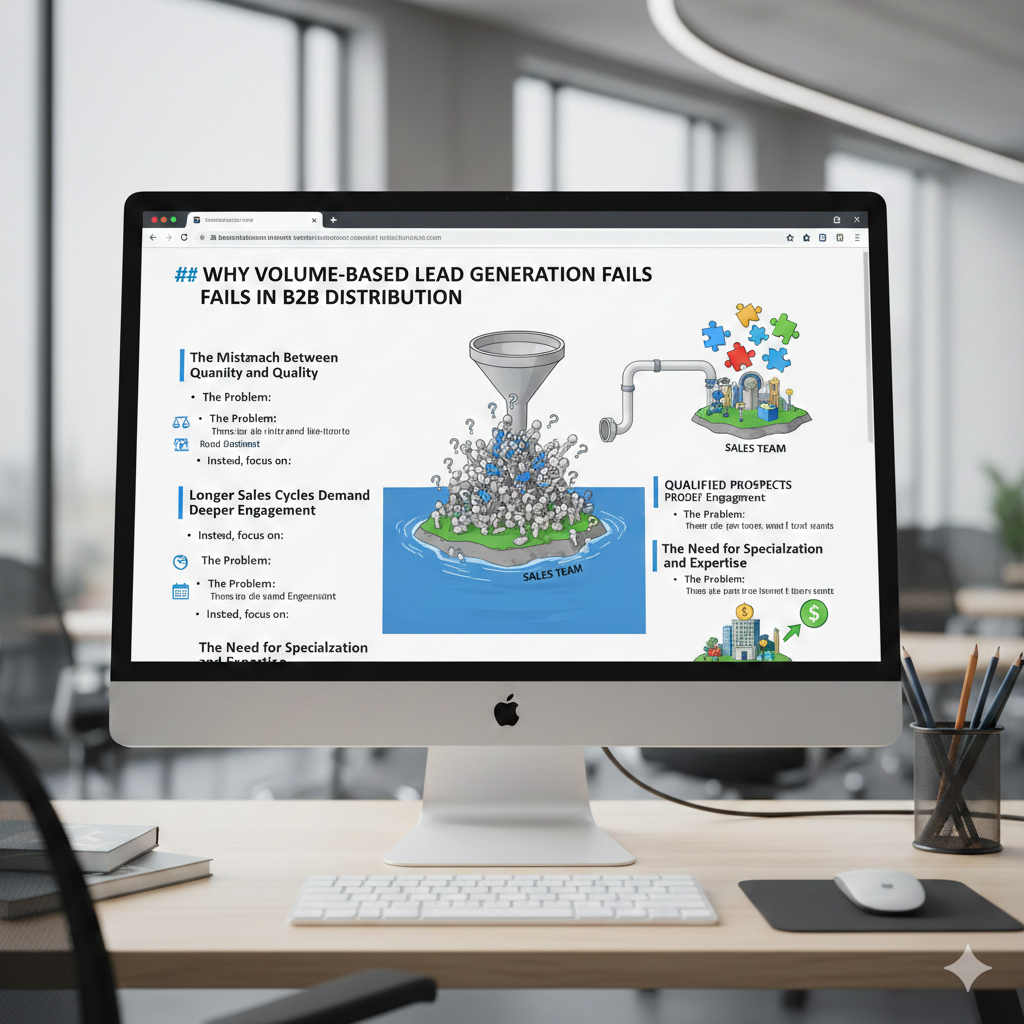
In the world of B2B distribution, growth is often equated with numbers: more leads, more outreach, more emails, more calls. On paper, volume-based lead generation appears logical the larger the funnel, the greater the output.
But in practice, especially in industries like construction materials, wholesale building supplies, manufacturing, and industrial distribution, volume rarely equals value.
At Intuitico, we work closely with B2B distributors who are discovering that chasing lead quantity often results in lower ROI, longer sales cycles, and strained sales teams. In this article, we’ll break down why volume-based lead generation fails in B2B distribution and what works better.
What Is Volume-Based Lead Generation?
Volume-based lead generation focuses on maximizing the number of leads entering the sales funnel. It often involves:
Buying large contact lists
Broad, untargeted email campaigns
Generic paid ads
High-frequency cold outreach
Measuring success by lead count rather than revenue
This strategy can work in transactional, low-ticket B2C environments. But B2B distribution operates under very different dynamics.
Why It Fails in B2B Distribution
1. B2B Distribution Is Relationship-Driven
Unlike SaaS sign-ups or eCommerce transactions, distribution is built on:
Long-term contracts
Repeat purchasing
Trust and reliability
Logistics coordination
Credit relationships
A purchasing manager sourcing millwork, cabinets, hardware, or construction materials is not making impulse decisions. They are minimizing risk.
A generic blast campaign does not build trust it builds noise.
2. Most Leads Are Structurally Unqualified
In B2B distribution, qualification goes far beyond job title.
You must consider:
Company size and purchasing volume
Geographic service area
Supplier compatibility
Existing contracts
Operational capacity
Industry specialization
Volume-based systems ignore these filters. The result?
Sales teams waste time chasing companies that:
Don’t buy at scale
Are outside service regions
Already have exclusive supply agreements
Are not financially aligned
More leads. Less revenue.
3. Sales Cycles Are Longer and Precision Matters
Distribution sales cycles are typically 3–12 months, sometimes longer. The cost of misalignment compounds over time.
If your pipeline is filled with poor-fit leads:
Forecasting becomes inaccurate
Sales morale declines
Follow-up resources are misallocated
Marketing ROI becomes impossible to measure
Volume-based lead gen prioritizes activity over strategy. But in distribution, strategic targeting outperforms brute force.
4. Operational Strain and Margin Erosion
Every new account introduces operational complexity:
Inventory planning
Credit approvals
Delivery routing
Account management time
If leads are low quality, distributors risk onboarding accounts that:
Order inconsistently
Demand heavy support
Negotiate aggressively on margins
Increase logistics costs
This erodes profitability — even if top-line revenue appears to grow.
5. Data Is Underutilized or Misused
Many distributors sit on powerful internal data:
SKU-level purchasing trends
Customer lifecycle value
Regional demand fluctuations
Industry segmentation
Rep performance data
Volume-based lead generation ignores this data in favor of external quantity.
Smart growth starts internally — not externally.
What Actually Works: Precision-Based Growth
If volume fails, what replaces it?
The answer is data-driven targeting combined with strategic positioning.
Here’s what high-performing distributors focus on instead:
1. Ideal Customer Profile (ICP) Development
Rather than asking:
“How do we get more leads?”
Ask:
“What does our most profitable customer look like?”
Define:
Industry vertical
Revenue range
Purchasing patterns
Geography
Order frequency
Margin contribution
Once you know your ICP, outreach becomes targeted and efficient.
2. Account-Based Outreach
Instead of 10,000 cold emails, try 200 highly relevant accounts.
Account-based strategies include:
Customized messaging
Market-specific value propositions
Direct engagement with decision-makers
Insights-based positioning
Quality conversations beat high bounce rates.
3. Data-Led Territory Optimization
Distribution is geographically sensitive.
Use analytics to:
Identify underserved territories
Analyze competitor density
Evaluate logistics efficiency
Map demand clusters
This ensures growth aligns with operational strength.
4. Revenue-Focused Metrics
Shift performance measurement from:
Number of leads
to:Cost per qualified opportunity
Conversion rate by segment
Average deal value
Lifetime value
Gross margin per account
This reframes marketing and sales as revenue partners - not volume generators.
The Hidden Cost of “More”
Volume-based lead gen often feels productive because it generates activity:
More CRM entries
More calls
More meetings
But activity without alignment leads to:
Pipeline inflation
Low close rates
Increased churn
Internal inefficiency
In B2B distribution, growth is not about acceleration it’s about alignment.
How SEO Fits Into Modern B2B Distribution Growth
If you’re investing in content (like this blog), SEO should not be an afterthought.
To ensure visibility, distributors should:
Target industry-specific keywords (e.g., “construction materials distributor analytics,” “B2B wholesale data insights”)
Write content that answers operational pain points
Optimize for long-tail search queries
Publish consistently
Focus on thought leadership rather than generic topics
SEO in B2B distribution works best when content demonstrates real industry expertise not marketing fluff.
Search engines reward authority. Buyers trust expertise.
A Better Growth Model for B2B Distributors
Instead of volume, think:
Insight → Targeting → Precision → Profitability
Modern distribution growth depends on:
Clean, structured internal data
Market intelligence
Customer segmentation
Analytics-driven strategy
Operational alignment
When data informs targeting, conversion improves naturally.
Final Thoughts
Volume-based lead generation fails in B2B distribution because it misunderstands the business model.
Distribution is not about clicks.
It’s about contracts.
It’s about logistics.
It’s about margin.
It’s about trust.
More leads do not guarantee growth. Better-fit customers do.
If your sales team feels busy but not productive or if your pipeline is full but revenue is flat the issue is likely structural, not tactical.
Let’s Build Smarter Growth
At Intuitico, we help B2B distributors transform raw data into strategic growth systems. We specialize in:
Market analytics
Customer segmentation
Revenue optimization
Data-driven expansion planning
If you're ready to move beyond volume-based lead generation and focus on profitable growth, we’d love to talk.
👉 Visit our website: https://intuitico.io
📩 Email us directly at “will.chen@imtuitico.io“ to start the conversation.
For a free 30 minutes consultation, you can book a meeting using this link:
https://calendly.com/will-chen-intuitico/30min
