What If You Could Understand a US County's Multi-Year Renovation Trend in Under 30 Seconds on Your Phone?
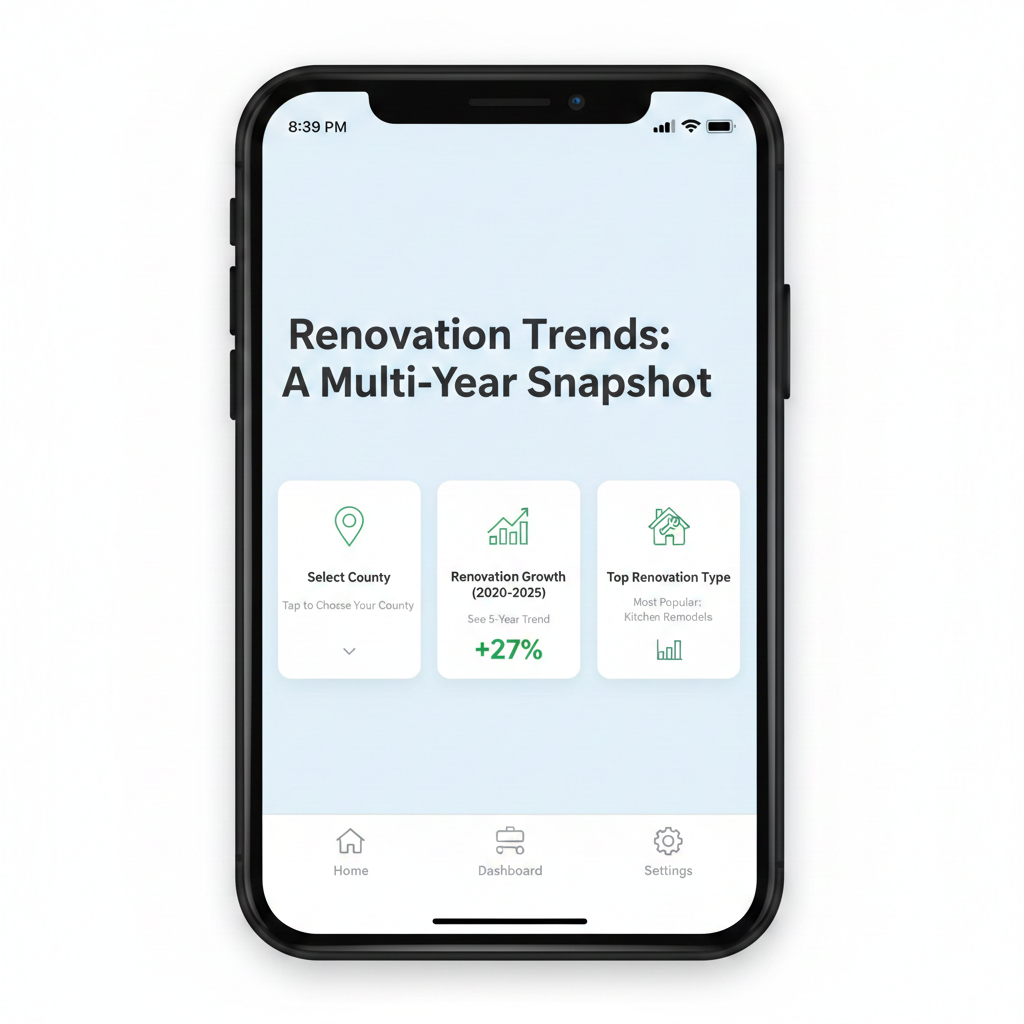
For companies operating in construction materials, home improvement, distribution, cabinetry, millwork, flooring, or real estate development, one challenge remains constant:
Knowing where demand is actually growing before everyone else does.
Traditionally, understanding renovation activity across U.S. counties required weeks of research. Analysts would gather permits data, housing reports, contractor activity signals, census trends, and fragmented regional statistics. Even after all that work, insights often arrived too late to drive action.
But what if you could open your phone and instantly see:
Which counties are experiencing sustained renovation growth?
Where remodeling activity has accelerated over multiple years?
Which markets are cooling down?
Where distributors and suppliers should expand coverage next?
And what if this took less than 30 seconds?
This is exactly the problem modern data intelligence is solving.
In this article, we explore how multi-year renovation trend intelligence is transforming decision-making across the construction ecosystem - and how businesses can leverage this shift.
Why Renovation Trends Matter More Than New Construction
While new housing starts often get the headlines, renovation activity represents a massive and more stable market.
In many U.S. counties:
Aging housing stock drives remodeling demand.
Rising interest rates reduce new home purchases but increase renovation spending.
Homeowners upgrade rather than relocate.
Rental and multifamily units undergo frequent upgrades.
For suppliers, distributors, and manufacturers, renovation markets often produce more consistent demand than new construction cycles.
However, renovation activity is fragmented and localized. One county may experience booming upgrades while another stagnates.
Without localized intelligence, companies often rely on guesswork or outdated reports.
The Old Way: Slow, Expensive, and Fragmented
Historically, analyzing renovation activity meant:
Pulling permit data from hundreds of municipalities
Cleaning inconsistent county datasets
Hiring analysts to normalize numbers
Waiting months for reports
Making decisions based on outdated trends
By the time insights arrived, market conditions had already changed.
Sales and expansion teams often relied on:
Anecdotal contractor feedback
Distributor opinions
Manual spreadsheet analysis
Regional assumptions
This approach worked when markets moved slowly. It does not work in today's data-driven environment.
The New Way: Real-Time County-Level Insight
Modern analytics platforms now integrate multiple data sources to generate multi-year renovation intelligence at county level.
This includes:
Historical renovation permit activity
Residential upgrade patterns
Contractor engagement signals
Housing turnover data
Remodeling spending trends
Market acceleration or slowdown indicators
When these signals are combined and normalized, businesses can instantly see:
Counties gaining renovation momentum
Markets showing sustained remodeling investment
Areas reaching maturity
Emerging opportunities before competitors notice
And all this can be accessed in seconds on a mobile device.
Why Multi-Year Trends Matter More Than Single-Year Data
A single year's data can be misleading.
For example:
A county might show a one-year spike due to disaster rebuilding.
Permit activity could temporarily slow due to backlog processing.
Pandemic-era distortions affected multiple regions unevenly.
Multi-year trend analysis smooths these anomalies.
It answers critical questions:
Is renovation demand consistently growing?
Is the market stable or volatile?
Is growth accelerating or plateauing?
Companies that base expansion decisions on sustained trends rather than short-term spikes make significantly better investments.
Business Impact Across the Industry
1. Building Material Suppliers
Suppliers can identify where demand for cabinets, flooring, fixtures, and materials is rising and shift inventory accordingly.
Result:
Better stock positioning
Reduced logistics costs
Improved distributor partnerships
2. Distributors & Wholesalers
Distribution networks benefit from knowing which counties deserve stronger sales coverage.
Result:
Smarter warehouse expansion
Optimized delivery routes
Higher sales productivity
3. Manufacturers
Manufacturers can prioritize regions where product demand will grow.
Result:
Better production forecasting
Stronger channel partnerships
Reduced market entry risk
4. Sales & Business Development Teams
Sales reps no longer rely solely on instinct or scattered leads.
Result:
Territory optimization
Targeted outreach
Increased win rates
5. Investors & Real Estate Developers
Investors can detect renovation-driven appreciation markets early.
Result:
Better acquisition decisions
Higher ROI potential
The Power of Mobile Access
Decision-makers are rarely sitting behind desks.
They are:
Visiting distributors
Meeting contractors
Touring facilities
Evaluating expansion locations
Having county-level intelligence available on a phone allows leaders to validate decisions in real time.
Imagine standing in front of a potential warehouse site and instantly knowing:
Renovation demand trend
Growth trajectory
Competitive landscape signals
This is the competitive edge data provides.
Speed Equals Advantage
Markets move quickly.
When insights take months to produce, companies react instead of lead.
But when intelligence becomes instantly accessible:
Expansion becomes proactive
Sales becomes targeted
Strategy becomes data-driven
Companies that move early often secure partnerships and territories before competitors arrive.
We are entering a phase where construction and renovation markets are becoming as data-driven as finance and e-commerce.
The next competitive frontier is:
Turning fragmented market signals into usable intelligence.
Businesses that leverage analytics will:
Reduce uncertainty
Improve ROI on expansion
Increase sales effectiveness
Make smarter investments
And they will do so faster than competitors relying on intuition.
Why Renovation Trend Intelligence Matters Online
From a digital strategy standpoint, businesses researching markets increasingly search online for terms such as:
US county renovation trends
Remodeling market data by region
Construction demand analytics
Housing renovation insights
Building material demand forecasts
Publishing insights around renovation analytics allows companies to:
Attract industry decision-makers organically
Build authority in construction intelligence
Capture high-value B2B traffic
Position themselves as data leaders
SEO-focused, insight-driven content ensures businesses are discovered precisely when decision-makers seek answers.
Final Thought
The question is no longer whether renovation intelligence matters.
The real question is: How quickly can your business access it - and act on it?
If understanding multi-year renovation trends across U.S. counties can now take under 30 seconds, companies that leverage this advantage will lead the next phase of growth in construction and building materials.
Ready to Make Data-Driven Decisions?
Discover how Intuitico helps construction materials suppliers, distributors, and manufacturers unlock powerful market intelligence and growth opportunities.
Visit our homepage: https://intuitico.io
Please reach out to us via email at “will.chen@intuitico.io“ through our website contact details to start the conversation.
For a free 30 minutes consultation, you can book a meeting using this link:
https://calendly.com/will-chen-intuitico/30min”
