The Rental Ripple Effect: Turning Population Shifts into a Recurring Revenue Strategy
When sales leaders analyze a county, most look at permits, loan volumes, and historical revenue. Those metrics matter but they’re reactive.
If you want a predictive edge, you need to start with population flow.
As part of our ongoing county-level market research series, we analyzed Tarrant County, Texas using Intuitico’s Housing Trend Data Lab. The county’s population has steadily climbed toward 2.26 million residents by 2025 approximately 1.2% annual growth.
That may sound incremental.
Strategically, it’s transformational.
This is what we call the Rental Pivot a powerful “Sales Signal” that reshapes how building materials suppliers should allocate resources, structure key accounts, and forecast recurring demand.
Population Growth Doesn’t Just Sell Homes. It Rewires Demand.
A 1.2% annual population increase doesn’t simply mean more homes being purchased.
It triggers a structural shift in:
Rental density
Multifamily turnover
Property management scale
Ongoing maintenance cycles
Institutional ownership
In other words, it changes who your customer should be.
For sales leaders in building materials, this demographic pressure creates two major strategic advantages.
1. The Resilience of Rental Demand
Not every new resident enters the market as a buyer especially during periods of tighter liquidity or higher interest rates.
Instead, population growth fuels:
Higher apartment occupancy
Increased rental housing conversions
Multifamily renovation cycles
Accelerated unit turnover
Rental properties don’t pause when mortgage rates fluctuate. They operate on a continuous refresh cycle.
Every turnover typically requires:
Flooring replacement
Paint and drywall updates
Cabinet and hardware swaps
Plumbing and lighting repairs
Exterior maintenance
These are high-frequency, recurring revenue streams.
Unlike new construction which can slow significantly in uncertain financial climates property maintenance remains operationally mandatory.
This is why the Rental Pivot is so powerful. It shifts your strategy toward segments that produce stable, repeatable revenue rather than episodic spikes.
2. Property Management as a Strategic Key Account
As population density increases, property ownership becomes more institutional and professionally managed.
This creates a major opportunity:
Stop selling door-by-door. Start selling portfolio-by-portfolio.
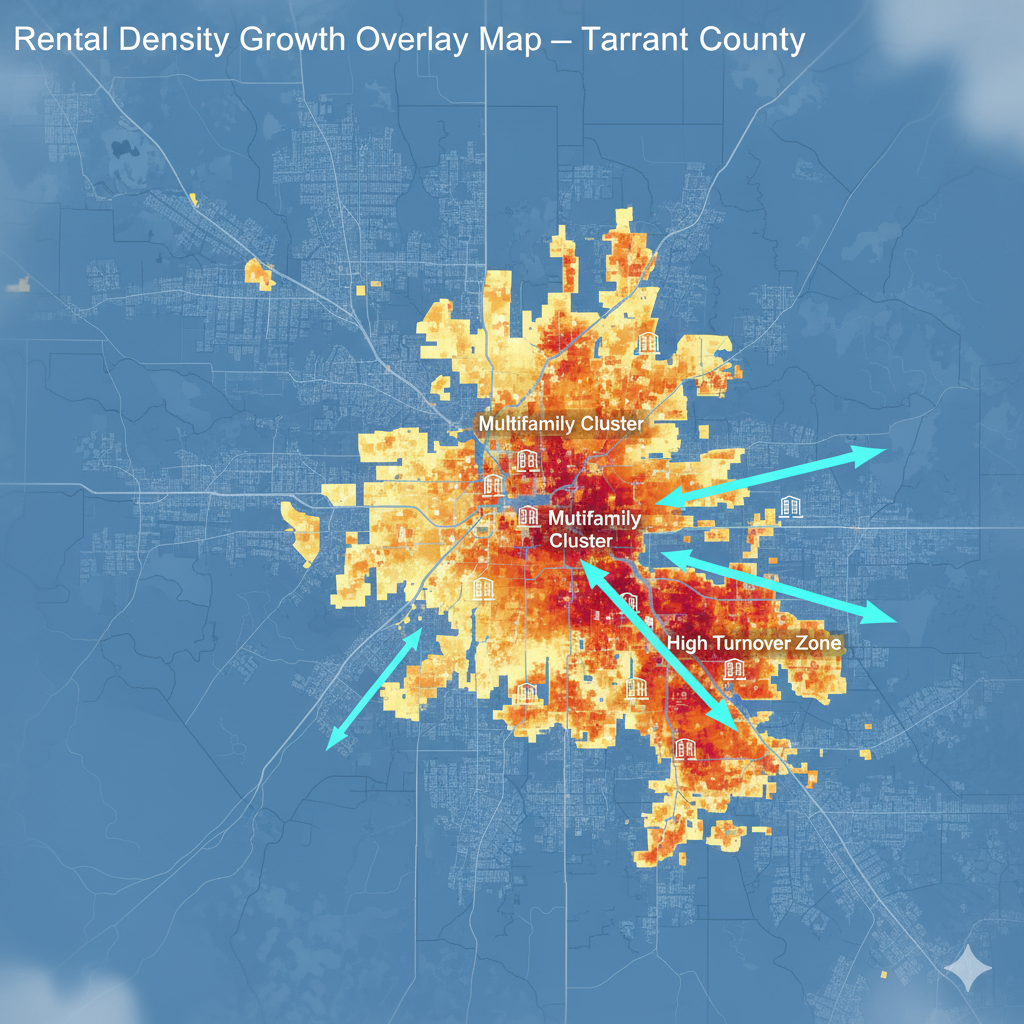
Using the Scalpel Strategy, we identify which pockets of Tarrant County show the highest rental density. Instead of allocating reps broadly, we concentrate effort in micro-territories where:
Multifamily units cluster
Turnover rates are high
Institutional property managers operate
Renovation budgets are recurring
When your team targets property management groups overseeing thousands of doors, the conversation changes from transactional to strategic.
Instead of:
“Can I quote this one project?”
You move to:
“How can we standardize your flooring and hardware program across 3,000 units?”
That shift creates:
Predictable order cadence
Bulk pricing agreements
Long-term supply relationships
Reduced customer acquisition cost
The Scalpel Strategy: From Demographic Trend to Lead Generation Map
The Rental Ripple Effect becomes actionable when population growth is layered with property type data.
Our Housing Trend Data Lab overlays:
Population growth rates
Multifamily density
Rental concentration zones
Home equity data
Loan-backed renovation signals
The result is not just a statistic.
It’s a Lead Generation Map.
You can visually pinpoint where:
Rental turnover will intensify
Property management concentration is rising
Maintenance demand will cluster
Supply partnerships will be most defensible
This transforms sales planning from reactive territory management into predictive account targeting.
Integrating This Into Your 2026 Sales Strategy
If you’re planning your 2026 roadmap, here’s how to operationalize the Rental Pivot:
1. Redefine Territory by Density, Not ZIP Code
Traditional geographic boundaries ignore rental clustering. Redraw territories around density corridors.
2. Build a Property Management Account List
Rank accounts by door count, renovation frequency, and location within high-growth zones.
3. Adjust Inventory Mix
Stock toward:
Durable flooring solutions
Cost-efficient cabinet systems
Fast-turn hardware
Paint and surface materials optimized for turnover
4. Align Sales Compensation to Recurring Accounts
Reward long-term contracts and recurring maintenance programs not just one-off projects.
The SEO Advantage: Why Rental-Focused Content Wins Visibility
From a digital strategy perspective, demographic-based analysis strengthens search authority.
Content optimized around:
“Tarrant County rental growth”
“Multifamily renovation demand Texas”
“Property management building materials strategy”
“Population growth impact on housing demand”
positions your brand as a regional intelligence authority.
Search engines prioritize:
Data-backed insights
Localized analysis
Industry-specific expertise
Forward-looking forecasts
By consistently publishing county-level housing intelligence, Intuitico strengthens domain authority while attracting decision-makers actively searching for strategic guidance.
The Bigger Picture: Population Surge or Decline
While Tarrant County represents a growth example, the Scalpel Strategy works in reverse as well.
In counties experiencing population decline:
Rental consolidation increases
Institutional operators acquire distressed assets
Renovation shifts toward repositioning and efficiency upgrades
The principle remains the same:
Population flow dictates revenue flow.
Ignoring it means planning without structural context.
The Bottom Line
The Rental Ripple Effect is not theoretical.
It is measurable, predictable, and monetizable.
A steady 1.2% population increase creates:
More renters
Higher rental density
Professionalized property management
Recurring renovation cycles
For building materials sales leaders, this is not just demographic trivia.
It is a tactical advantage.
Ready to Sharpen Your Regional Targeting?
At Intuitico, we help building materials manufacturers, distributors, and suppliers translate demographic shifts into precise, actionable sales strategies.
If you’re preparing your 2026 regional plan and want to:
Identify high-density rental corridors
Target property management portfolios
Align inventory with recurring demand
Build a predictive sales roadmap
Visit our homepage to learn more: https://intuitico.io
Or email us directly at “will.chenA@intuitico.io“ to start the conversation.
For a free 30 minutes consultation, you can book a meeting using this link:
”https://calendly.com/will-chen-intuitico/30min”
