Best Practices for Distributor Customer Journey Mapping (Analytics + Personalization)
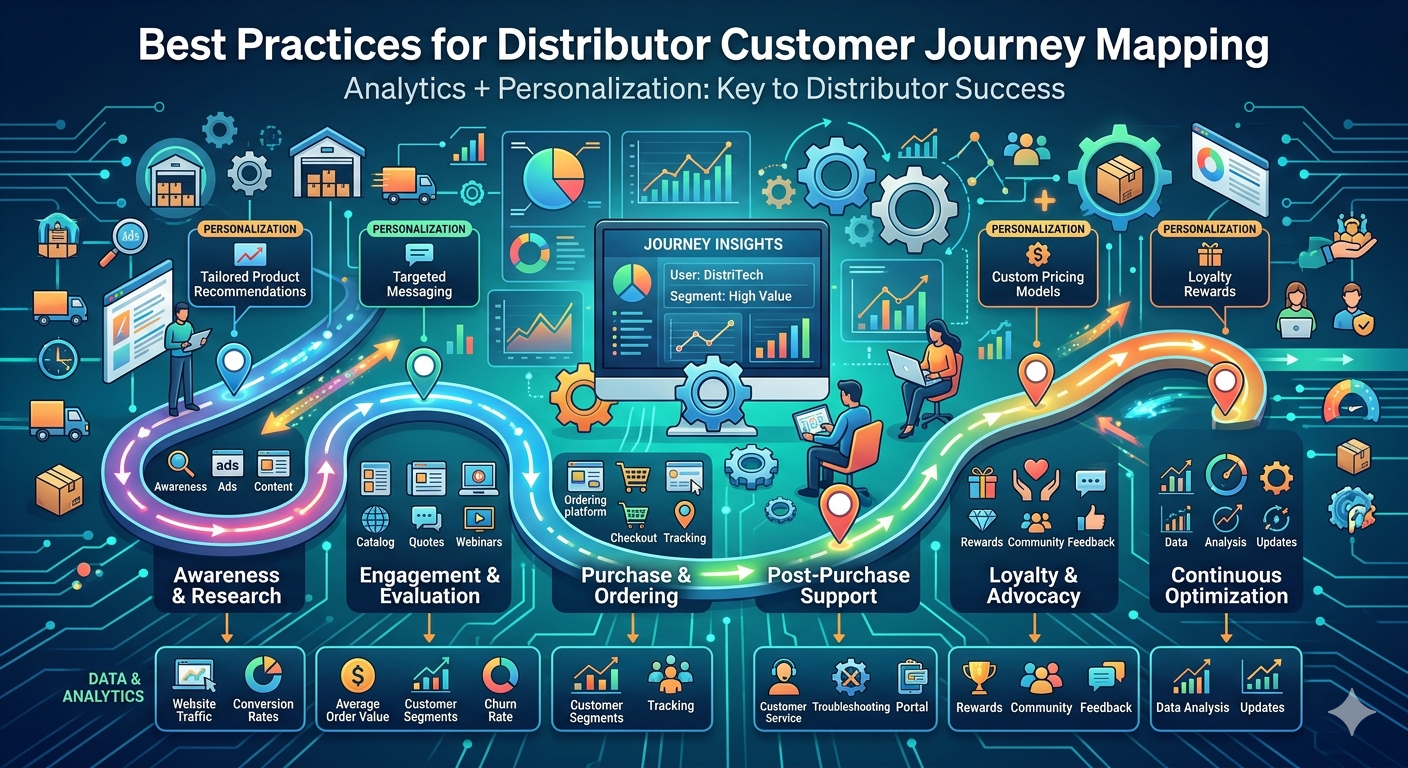
In the distribution industry whether building materials, industrial supplies, or wholesale products customer expectations are evolving quickly. Buyers expect fast information, personalized recommendations, and seamless interactions across channels.
For distributors, the challenge is clear: how do you understand and optimize every interaction a customer has with your business?
The answer lies in customer journey mapping powered by analytics and personalization. When done well, journey mapping provides a clear view of how customers discover, evaluate, purchase, and reorder products—allowing distributors to remove friction and create smarter, data-driven experiences.
In this article, we explore best practices for distributor customer journey mapping and how analytics and personalization can transform the customer experience while driving measurable growth.
What Is Customer Journey Mapping?
Customer journey mapping is the process of visualizing every interaction a customer has with your company from the moment they first become aware of your brand to long-term loyalty and repeat purchasing.
A journey map helps organizations understand customer actions, needs, and pain points across every touchpoint.
For distributors, these touchpoints may include:
Website product searches
Pricing inquiries
Quote requests
Sales calls
Order placement
Delivery and fulfillment
Customer service interactions
Reorders and long-term contracts
Mapping this journey provides a holistic view of the buying experience, allowing teams to identify friction points and opportunities for improvement.
Why Journey Mapping Matters for Distributors
Unlike traditional retail or e-commerce, distribution businesses often deal with:
Complex product catalogs
Contract pricing and negotiated terms
Multi-stakeholder purchasing decisions
Recurring or bulk orders
Long-term client relationships
Because of this complexity, the buying journey is rarely linear.
Today’s B2B buyers might:
Research products online
Contact a sales rep
Request a quote
Compare distributors
Place a trial order
Integrate into long-term purchasing cycles
Understanding these behaviors requires analytics-driven visibility across multiple channels and interactions.
Customer journey mapping allows distributors to:
Identify drop-off points in the sales process
Improve customer acquisition and conversion rates
Increase customer lifetime value
Deliver personalized experiences at scale
Ultimately, it turns customer data into actionable insight.
The Role of Analytics in Journey Mapping
Analytics is the backbone of modern journey mapping. Instead of relying on assumptions, distributors can use real behavioral data to understand how customers interact with their business.
Data sources typically include:
Website analytics and search behavior
CRM and sales pipeline data
Quote and order history
Customer service tickets
Marketing campaign performance
Product usage or reorder patterns
By integrating these sources, organizations can build a 360-degree view of the customer journey across all touchpoints.
Advanced analytics can also reveal:
Which marketing channels generate the best leads
Where customers abandon the buying process
How long purchasing cycles take
Which customer segments drive the most revenue
These insights allow distributors to move from reactive decision-making to predictive strategy.
Personalization: The Next Step in Journey Optimization
Once distributors understand the customer journey through analytics, the next step is personalization.
Personalization tailors the customer experience based on behavior, preferences, and historical interactions.
For distributors, personalization can include:
Product Recommendations
Suggest complementary products or commonly bundled items.
Account-Specific Pricing and Catalogs
Display relevant products and contract pricing for each customer.
Personalized Marketing
Send targeted emails or promotions based on past purchases.
Predictive Reordering
Notify customers when it’s time to reorder frequently purchased items.
Customized Content
Provide guides, case studies, or product specifications relevant to specific industries.
These strategies create a more relevant and efficient buying experience, increasing both satisfaction and repeat business.
Best Practices for Distributor Customer Journey Mapping
1. Start with Customer Personas
Journey maps should reflect the experiences of specific customer segments, not an average buyer.
Common distributor personas may include:
Procurement managers
Contractors or installers
Retail resellers
Project managers
Operations teams
Each persona may interact with your business differently and require unique messaging and support.
2. Map Every Key Touchpoint
Identify every interaction customers have with your company.
Typical distributor touchpoints include:
Online product search
Website or catalog browsing
Sales consultations
Quote generation
Order placement
Delivery tracking
Technical support
Mapping these interactions helps teams identify gaps and inconsistencies in the customer experience.
3. Combine Quantitative and Qualitative Data
Effective journey maps combine:
Quantitative data
Conversion rates
Order values
Website behavior
Sales cycle length
Qualitative insights
Customer interviews
Feedback surveys
Sales team insights
This combination reveals not just what customers do but why they do it.
4. Identify Friction and Drop-Off Points
One of the biggest benefits of journey mapping is identifying friction in the buying process.
Examples may include:
Complicated quote requests
Slow response times from sales teams
Difficult product searches
Limited online ordering capabilities
By identifying these obstacles, distributors can streamline processes and increase conversions.
5. Use Predictive Analytics
Advanced distributors are beginning to leverage predictive analytics to anticipate customer needs.
Predictive models can identify:
Customers likely to churn
High-value prospects
Products likely to be reordered soon
Opportunities for cross-selling
This enables proactive engagement rather than reactive sales efforts.
6. Align Sales, Marketing, and Operations
Customer journey mapping should not exist in a single department.
The most successful organizations ensure alignment across:
Marketing teams generating demand
Sales teams managing relationships
Operations teams handling fulfillment
Customer service teams resolving issues
Cross-department collaboration ensures a consistent and seamless customer experience.
7. Continuously Update the Journey Map
Customer expectations and buying behaviors constantly evolve.
Journey maps should be treated as living documents, updated regularly as new data becomes available and market conditions change.
Organizations that continuously analyze and refine their customer journeys gain a long-term competitive advantage.
The Future: AI-Driven Journey Intelligence
The next generation of journey mapping combines analytics, AI, and automation.
AI can help distributors:
Detect patterns in large datasets
Predict future purchasing behavior
Trigger personalized messaging automatically
Optimize pricing and product recommendations
With the right technology infrastructure, distributors can transform their customer journey from a static diagram into a dynamic, data-driven system that adapts in real time.
Final Thoughts
Customer journey mapping is no longer just a marketing exercise—it is a strategic capability that enables distributors to compete in an increasingly digital marketplace.
By combining data analytics, behavioral insights, and personalization, distributors can:
Understand how customers actually buy
Remove friction from the purchasing process
Deliver tailored experiences across every touchpoint
Increase retention and long-term revenue
Organizations that invest in journey analytics today will be best positioned to build stronger customer relationships and sustainable growth in the future.
Work With Intuitico
At Intuitico, we help distributors unlock the value of their data.
Our analytics solutions are designed specifically for construction materials suppliers, building product distributors, and wholesale businesses, enabling them to better understand customer behavior and optimize decision-making.
If you’re interested in exploring how data analytics can improve your customer insights and operational performance, we’d love to hear from you.
Visit our website: https://intuitico.io
Or contact us directly to start the conversation.
Email us at “will.chen@intuitico.io“ to learn how analytics can transform your business.
For a free 30 minutes consultation, you can book a meeting using this link:
https://calendly.com/will-chen-intuitico/30min
